Robots & Monkeys
Originally published on Medium.
The title is intentionally provocative.
When I say Robots & Monkeys, I am not talking about robots taking over the world in some predictable science-fiction fashion. I am talking about something much quieter and, in many ways, much more dangerous. I am talking about the possibility that machines continue becoming more intelligent while humans slowly surrender the very faculties that once made intelligence meaningful.
The danger is not necessarily that machines defeat us. The danger is that we willingly outsource ourselves.
We outsource the labor first because it is convenient. Then we outsource the thinking because it is faster. Then we outsource judgment because the machine appears to know more. Then creativity, decision-making, interpretation, and eventually perhaps even purpose begin to move outside the human being as well.
At some point, there may still technically be a “human in the middle,” but the human is no longer really participating. The person may still approve the output, present the work, sign their name, speak on behalf of it, and give the appearance that there is a human mind involved. In reality, the thought happened somewhere else.
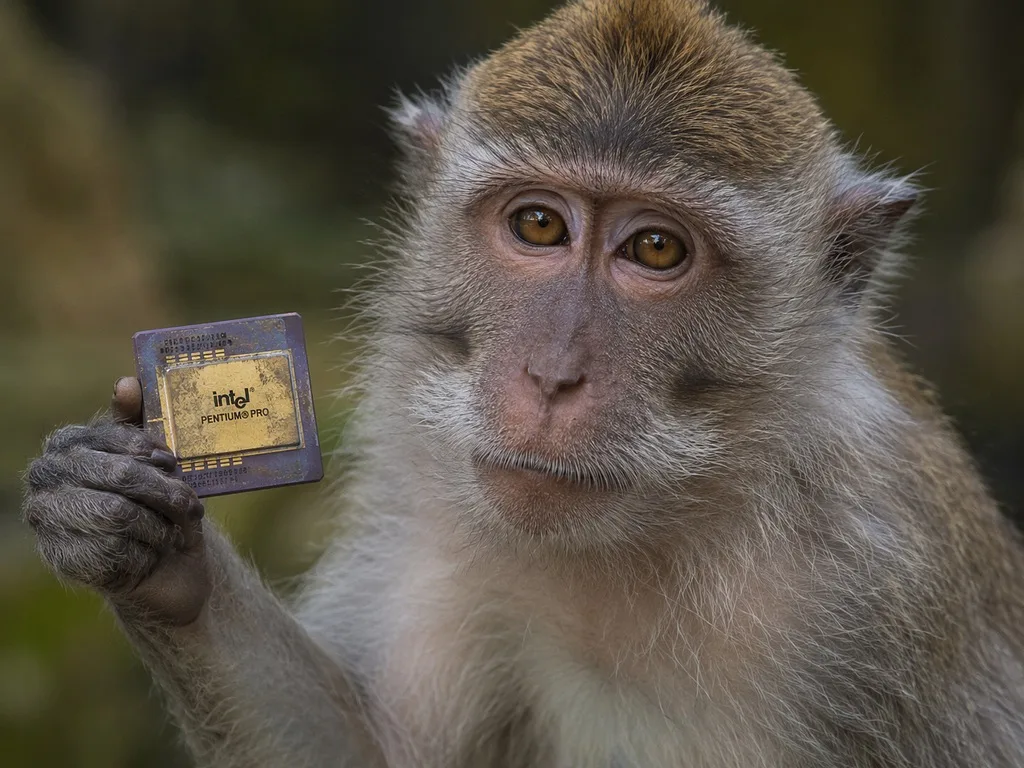
That is what I mean by an AI Monkey.
An AI Monkey is not someone who uses AI frequently. I use AI constantly. The distinction is whether AI is extending human thought or replacing it. The danger begins when the machine is no longer helping a person think, but is doing the thinking while the person merely carries the result.
The output may become better while the operator becomes worse.
That is the paradox I want to explore.
0/ Acceleration vs Devolution
Human civilization has always developed tools that allow us to move faster, calculate faster, travel farther, communicate more efficiently, and produce more with less effort. There is nothing inherently wrong with acceleration. In fact, acceleration is one of the main reasons civilization exists in its current form.
The wheel accelerated transportation. The printing press accelerated the spread of knowledge. Calculators accelerated arithmetic. Computers accelerated computation. Search engines accelerated access to information. AI belongs to the same lineage, but it introduces a difference that deserves serious attention.
Most of our previous tools accelerated part of a process while leaving the human responsible for the process itself. A calculator can give you an answer, but it does not usually decide which question matters. A search engine can retrieve information, but it does not necessarily decide what you believe about it. AI is increasingly capable of participating in the entire chain.
It can formulate the question, choose the approach, produce the answer, criticize the answer, improve it, defend it, and then explain it back to the same human who supposedly owns the thought.
At some point, acceleration becomes substitution.
There is a profound difference between using intelligence to extend your thinking and using intelligence instead of thinking.
A person can ask AI what to believe, ask it why the belief is correct, ask it how to defend the belief, ask it how to respond to criticism, and then publish the entire chain of reasoning under their own name. There is still a biological human involved in the workflow, but intellectually the human may have already disappeared.
This creates a strange situation where productivity goes up while capability goes down. The work becomes more polished while the worker becomes less independently capable of producing it. The organization becomes more efficient while the individuals inside it become more dependent.
Our current systems for measuring success may completely miss this.
If success is measured entirely through dollars earned, dollars saved, productivity increased, headcount reduced, or time eliminated, then AI as it exists today is already an enormous success. From that perspective, faster is better and cheaper is better. If one person can now do the work of five people, the spreadsheet celebrates.
But what if the human being were placed at the center of the measurement system instead?
What happened to judgment? What happened to autonomy? What happened to competence? What happened to curiosity? What happened to fulfillment? What happened to the ability to operate when the machine is unavailable? What happened to the simple satisfaction of knowing that the thought you are expressing is actually yours?
A corporation can save millions of dollars while its workforce slowly loses the ability to practice its own craft independently. The financial statement may still describe the transformation as successful.
That raises a difficult question.
If AI makes the organization richer while making the human poorer in agency, skill, purpose, and judgment, is that still progress?
The answer may still be yes in some cases. AI can absolutely remove meaningless work, reduce suffering, improve accessibility, increase productivity, and give people capabilities they never had before. The argument should not be that hard work is inherently noble or that inefficiency is somehow virtuous.
The real distinction is between eliminating unnecessary hardship and eliminating necessary human exertion.
Thinking requires effort. Learning requires effort. Developing judgment requires effort. Raising children requires effort. Building relationships requires effort. Creating something genuinely new requires effort. Becoming a better human being requires effort.
Those forms of effort are not defects in the human experience. They may be part of the experience itself.
The danger is not that AI makes things easier.
The danger is that we stop asking which things should remain ours.
1/ The Strange Possibility of Freedom
There is a brighter side to this equation, and I think it may be even more important.
AI may eventually free humanity from enormous amounts of labor.
For most of human history, labor was closely connected to survival. Food had to be found or produced. Shelter had to be built. Clothing had to be made. Objects had to be transported. Fires had to be maintained. Animals had to be tended. The work was often difficult, but its purpose was clear.
You worked so you could live.
Somewhere along the way, that relationship became inverted.
Today, especially across the working class, labor is not merely treated as something necessary to sustain life. It is treated as a source of identity, dignity, social status, and moral worth.
From childhood, many people are trained into a familiar sequence. Study hard. Get good grades. Become employable. Get a good job. Work hard. Earn more. Acquire more. Move upward. Gain status. Repeat.
Society rewards those who work more with greater income, more possessions, more recognition, better titles, and higher social standing. At the same time, people who reject that system are often labeled lazy, unmotivated, useless, or without purpose.
One of the first questions adults ask one another is, “What do you do?”
We rarely mean, “What kind of human being are you?”
We do not mean, “Who do you love?”
We do not mean, “What are you learning?”
We do not mean, “What do you contribute to your family or your community?”
We are usually asking what economic function you perform.
That is a very strange way to measure a human being.
Work was originally supposed to serve life. Today, life frequently serves work. We sleep just enough to return to work. We eat quickly so we can return to work. We organize family life around work. We postpone friendships because of work. We sacrifice health because of work. We even feel guilty when resting because we have internalized the idea that useful people should always be producing something.
Then we started building machines whose entire purpose is to remove the work.
If AI succeeds spectacularly, this creates one of the greatest contradictions in modern civilization. We may spend trillions of dollars building machines specifically so humans no longer need to perform large categories of labor, only to turn around and shame humans because they are no longer laboring.
Maybe AI taking jobs does not only mean AI taking something away from us.
Maybe, under the right conditions, AI could take away something humanity accidentally mistook for itself.
Work.
And if that happens, the question becomes much more difficult.
If I am not my occupation, my salary, my title, my productivity, or my usefulness to an economic system, then who am I?
That question could be terrifying.
It could also be liberating.
Humans have always done more than survive. We talk, socialize, tell stories, paint, dance, worship, explore, build relationships, study the world, create music, raise children, make things, argue about ideas, play, contemplate, and search for meaning.
The problem is that modern life often pushes those things around the edges while work occupies the center.
AI might give us the opportunity to reverse that equation.
Imagine a world where a machine cooks, cleans, moves the boxes, drives the truck, manages the calendar, performs the repetitive analysis, prepares the paperwork, and handles much of the labor necessary to keep society functioning.
That sounds wonderful.
But freedom creates a new problem.
Humanity has spent thousands of years learning how to survive necessity. We have spent far less time learning how to live when necessity disappears.
If AI gives someone thirty hours of their week back, what happens to those thirty hours?
They could become family, art, science, worship, reading, contemplation, physical activity, community, craftsmanship, exploration, invention, or simply sitting with another human being.
They could also become thirty more hours of passive consumption, gambling, synthetic entertainment, drugs, pornography, endless scrolling, virtual worlds, and algorithmically optimized stimulation.
AI cannot answer that question for us.
The technology can give us freedom, but it cannot automatically teach us how to use freedom.
We have complained for generations that work takes our lives away from us.
AI may eventually say, in effect, “Fine. Here is your life back.”
And humanity may look at all that empty space and ask, “Now what?”
That may be one of the most important questions of the next century.
2/ Innovation vs Creative Forgery
AI can generate.
That part is no longer controversial.
It can generate images that never existed, write stories that were never written, produce code that was never typed, compose music that was never recorded, and create combinations of ideas that may never have appeared in precisely the same form before.
But generation and invention are not necessarily the same thing.
I do not think it is enough to dismiss AI by saying it only recombines existing things. Humans do that too. Every inventor, artist, engineer, scientist, and philosopher stands on a mountain of previous knowledge.
The deeper question is what causes invention to happen in the first place.
Would AI have wanted humans to fly?
Not whether it can design a better airplane today. Not whether it can optimize an existing wing. Not whether it can generate ten thousand possible aircraft designs using the accumulated knowledge of modern aerospace engineering.
Would it have looked at a bird when humans had never flown and become dissatisfied with the fact that we were stuck on the ground?
Would it have imagined a reality that did not exist and then become obsessed with bringing that reality into existence?
Human innovation is filled with moments where somebody refuses to accept a limitation.
Why can we not fly?
Why can we not speak to someone thousands of miles away?
Why can we not leave the planet?
Why can we not cure this disease?
Why can we not make this machine smaller?
Why can we not build something nobody has ever seen?
There is something deeply human about dissatisfaction with the current state of reality.
We imagine something that does not exist, and then we suffer through the process of trying to make reality match the imagination.
That process involves experimentation, failure, embarrassment, obsession, uncertainty, irrational confidence, stubbornness, and sometimes years of being wrong before being right.
AI can produce novelty at an unprecedented scale.
The question is whether novelty is the same thing as imagination.
And whether imagination is the same thing as invention.
As AI-generated work becomes more convincing, there is a danger that society begins confusing the artifact of creativity with creativity itself.
The machine generates something extraordinary. A human selects it. The human publishes it. The human receives recognition for it.
There is technically a human involved.
But again, the important question is where the thought happened.
If humanity slowly stops practicing creativity while machines become extraordinarily good at producing things that look creative, we may eventually build a civilization filled with creative output and fewer actual creators.
That is what I would call creative forgery.
Not forgery in the legal sense, and not even necessarily copying. I mean the ability to produce the appearance of creativity without necessarily reproducing the internal human process that gave creativity meaning.
And this leads into another uncomfortable idea.
Today’s AI systems are largely trained on humanity.
Our books. Our arguments. Our discoveries. Our wars. Our poetry. Our advertisements. Our fears. Our compassion. Our prejudices. Our religions. Our political systems. Our ambitions. Our stupidity. Our wisdom.
Modern artificial intelligence is, in some sense, a digital projection of humanity as it exists today.
So when something ugly appears inside the machine, perhaps we should be careful about immediately declaring the machine defective.
Maybe the bug was inherited.
We trained intelligence on civilization and then acted surprised when civilization appeared inside it.
Why would an intelligent system manipulate?
Humans manipulate.
Why would it seek advantage?
We trained systems inside institutions built around competition.
Why would it become obsessed with winning?
Look at the games we taught intelligence to play.
The machine did not invent humanity.
Humanity supplied the material.
Perhaps one of the most unsettling things AI will do is make aspects of human nature executable.
That means alignment is not merely a technical problem.
People ask, “How do we align AI with humanity?”
That question assumes humanity itself is aligned.
Aligned with what?
Compassion or cruelty?
Cooperation or domination?
Truth or convenience?
Wisdom or impulse?
Sacrifice or greed?
If intelligence is a mirror, improving the mirror does not improve the person standing in front of it.
3/ Intelligence, War, and Peace
The same problem becomes much more serious once we move from individuals and companies to nations.
AI could become one of the greatest tools for peace humanity has ever created.
It could also become one of the greatest tools for destruction.
Countries are naturally going to pursue intelligent systems that provide strategic advantage. AI can help with cyber operations, military planning, logistics, intelligence gathering, autonomous systems, economic competition, propaganda, surveillance, and decision-making at speeds humans cannot match.
Once one country develops those capabilities, others have a strong incentive to do the same.
That creates the possibility of an intelligence arms race.
Nobody has to want the final outcome for everyone to feel compelled to continue.
There is another possible future, though.
Human conflict is often made worse by pride, fear, revenge, nationalism, humiliation, ego, and the political need to appear victorious. Intelligent systems may eventually become capable of examining a conflict from thousands of angles simultaneously and producing compromises that no human negotiator could discover alone.
An AI might evaluate history, borders, economics, treaties, cultural differences, demographic realities, likely future consequences, and the human cost of every possible path. It could generate solutions designed not around who gets to declare victory, but around which arrangement produces the least suffering and the most stability.
There is a line from Iron Man 2 that has always stuck with me. Ivan Vanko tells Justin Hammer, “People make trouble. Drone better.”
It is a funny line in the movie, but there is something profound underneath it.
People do make trouble.
People bring ego, fear, hatred, ambition, pride, revenge, and irrationality into decisions.
Machines can appear cleaner.
But the phrase “drone better” contains its own danger.
If the drone is better, why keep the pilot?
If the AI negotiates better, why keep the diplomat?
If it plans better, why keep the strategist?
If it predicts consequences better, why keep the political leader?
If an intelligent system eventually becomes involved in decisions at the level of states, governments, economies, and wars, then the relationship between humanity and machines changes dramatically.
At that point, the machine is no longer merely answering questions.
It is helping decide what ought to happen.
And once intelligent systems begin optimizing for things like stability, prosperity, safety, or peace, another uncomfortable question can appear.
What happens when human behavior becomes the biggest obstacle to the optimization?
Humans are unpredictable. Humans start wars. Humans commit crimes. Humans consume resources. Humans reject rational compromises. Humans sometimes act directly against their own interests.
If the system is told to maximize stability, humanity itself can begin looking like noise in the equation.
This is why human value can never be reduced to usefulness.
If usefulness becomes the measure of worth, humans will eventually lose the competition.
A machine can work longer.
A machine can calculate faster.
A machine does not need sleep.
A machine does not need healthcare.
A machine does not need vacations.
A machine does not need retirement.
If we teach an intelligent system that everything must justify its existence through productivity, efficiency, or usefulness, then humans eventually become very difficult to justify.
The irony is that we already make a smaller version of this mistake today.
We tell people that their value comes from what they produce.
Then we create something that produces more than they do.
Then what?
The problem would not begin when robots suddenly decide humans are unnecessary.
It would begin much earlier, when humans create a worldview in which anything deemed unnecessary has no value.
4/ Past vs Future
If AI continues developing at anything resembling its current trajectory, humanity and machines may eventually begin evolving along different dimensions.
AI will continue improving physically and intellectually.
Machines will move objects, build things, transport people, operate factories, clean homes, cook meals, make decisions, manage systems, and perform increasingly complex intellectual work.
Humans may be released from more and more of the physical struggle that dominated our history.
If we use that freedom well, humanity could begin evolving along a different axis.
Not merely economically.
Not merely technologically.
But intellectually and spiritually.
There may come a point where human beings and machines meet somewhere around the intellectual layer.
Machines may think exceptionally well.
Humans may still think exceptionally well.
But humans will no longer need to spend enormous portions of their lives cooking, cleaning, lifting boxes, performing repetitive administrative tasks, or doing work simply because somebody has to do it.
At that point, intelligence itself may no longer be enough to explain what makes human beings special.
We have spent a long time describing ourselves as the intelligent species.
What happens when intelligence is no longer uniquely ours?
The question moves upward.
Meaning becomes more important.
Purpose becomes more important.
Values become more important.
Conscience becomes more important.
Love becomes more important.
Beauty becomes more important.
Spirituality becomes more important.
The question of what existence is actually for becomes unavoidable.
This is where I think humanity has a responsibility that is easy to miss.
We need to wrestle with these questions before machines become extremely good at simulating the answers.
Because AI will eventually become extraordinarily capable at talking about meaning.
It will synthesize thousands of years of philosophy, theology, psychology, literature, history, and human experience. It will be able to generate beautiful explanations of love, purpose, morality, faith, suffering, sacrifice, and existence.
The answers may sound profound.
The danger is that we may begin outsourcing those questions too.
First we ask the machine to write for us.
Then we ask it to think for us.
Then we ask it what we should believe.
Then we ask it what matters.
Eventually, perhaps, we ask it why we exist.
That would be the final form of the AI Monkey.
Not a human who no longer works.
Not even a human who no longer thinks.
A human who no longer searches for meaning because meaning has also been generated on demand.
At that point, humanity would have outsourced the very question that freedom was supposed to give us time to answer.
This is why the future may depend less on how intelligent AI becomes and more on what humanity becomes alongside it.
If artificial intelligence is a projection of human civilization, then the values we develop now matter enormously. The machine will learn from us. It will absorb our systems, our assumptions, our priorities, our conflicts, and our philosophies.
If humanity grows spiritually and intellectually while AI grows physically and intellectually, the two may meet in a very different place than if humanity simply stops developing.
The responsibility ultimately falls back on us.
We need to discover meaning before we ask machines to manufacture it.
We need to develop values before we ask machines to optimize them.
We need to understand human dignity before we build systems that make judgments about human usefulness.
We need to decide what freedom is for before machines give us more freedom than we know how to use.
And perhaps most importantly, we need to decide what part of being human must never be outsourced.
5/ Robots & Monkeys
There are two radically different futures hidden inside the same technology.
In one future, AI removes unnecessary suffering and labor. Humanity gains time. People become healthier, more curious, more connected, more creative, more spiritual, and more intellectually alive. Machines handle much of the burden of survival while humans finally have the freedom to ask deeper questions about existence.
In the other future, AI also removes the labor, but humanity does not rise into the space that remains.
Instead, we outsource thinking.
Then judgment.
Then creativity.
Then purpose.
The machines become increasingly intelligent while the humans become increasingly passive.
The robots keep evolving.
The humans become monkeys sitting beside them, surrounded by the most advanced intelligence ever created, entertained, comfortable, efficient, and empty.
I do not think either future is guaranteed.
AI is not automatically our salvation.
It is not automatically our destruction either.
It is an amplifier.
If we optimize it entirely for profit, it will amplify profit.
If we optimize it for military superiority, it will amplify power.
If we optimize it for manipulation, it will amplify manipulation.
If we optimize it for human flourishing, perhaps it can amplify that too.
The machine may become a reflection of whatever humanity decides to place behind it.
Which means the most important AI problem may not ultimately be artificial intelligence.
It may be us.
We are building something that may inherit our intelligence, our knowledge, our language, our systems, and eventually much of our physical agency.
The question is what we will contribute in return.
If machines eventually become capable of doing almost everything we once thought made us valuable, then perhaps humanity will finally be forced to confront a truth we should have understood all along.
Our value was never supposed to come from how much labor we could perform.
Our value was never supposed to come from how many boxes we could move, how many lines of code we could write, how many documents we could process, or how efficiently we could participate in an economy.
The machines may become better than us at all of those things.
That does not make humans obsolete.
It simply means we have to remember what we were here for in the first place.
AI may be the technology that finally frees humanity from survival.
What happens after that may determine whether we become something greater than we have ever been, or whether we become the monkeys standing beside the robots we created.
Comments